Fed Holds Rates in October 2026: What It Means for San Antonio Buyers and Sellers
The Federal Reserve left its benchmark interest rate unchanged today at 3.75% to 4.00%, but two voting members wanted to raise it.
The short version
No change today. The Fed is holding after raising rates in September, and inflation is still running above its 2% goal.
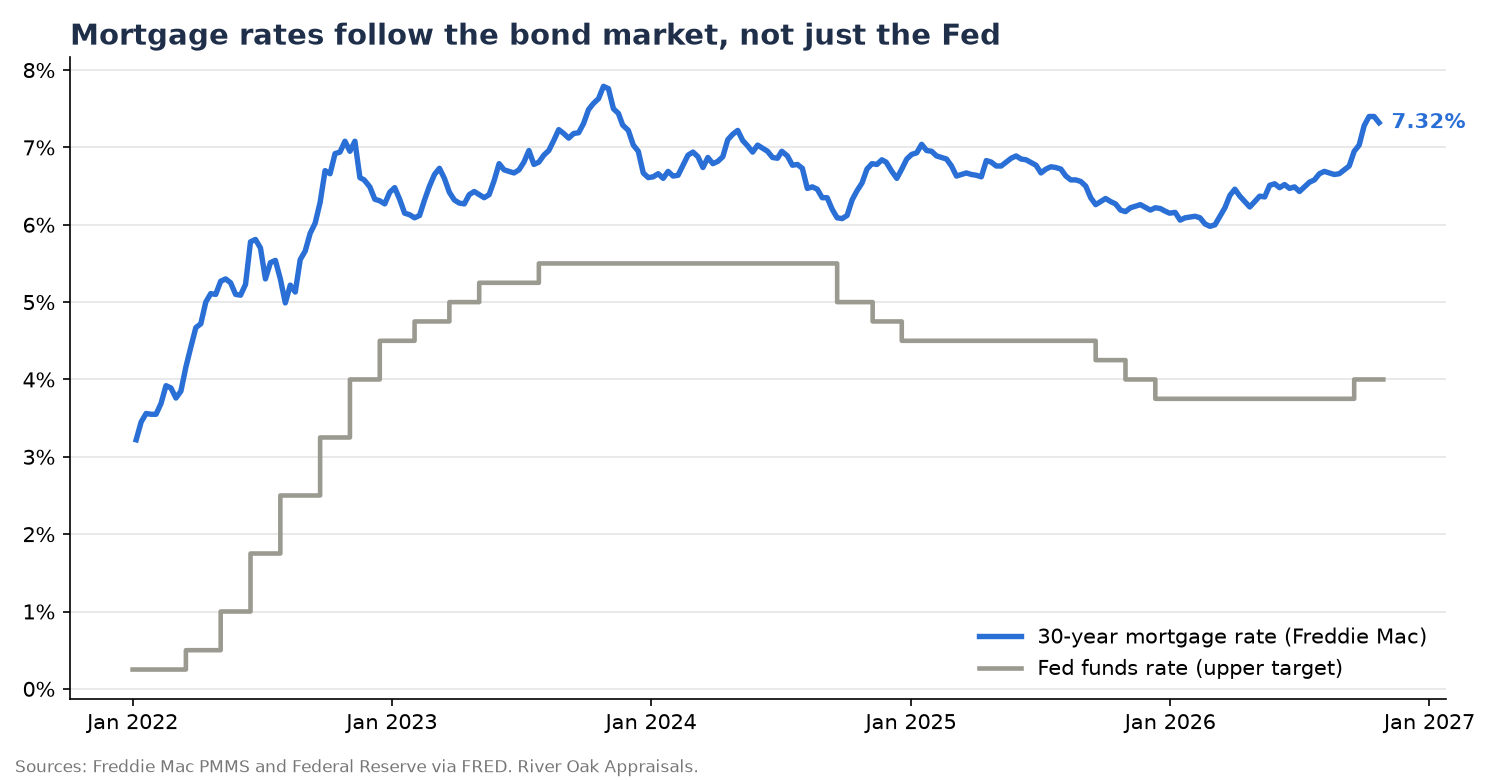
Don't expect relief on mortgage rates from this. The 30-year fixed is a little above 7%, tied to a 10-year Treasury yield that is sitting near 5%.
Markets expect a hike in December. Betting markets and futures traders both put the odds at roughly three in four.
What the Fed did and why
The vote was 10 to 2. Governor Lisa Cook and Cleveland Fed President Beth Hammack voted against it because they wanted a quarter-point hike today.
Some context: the Fed raised its key rate last month for the first time in three years, and Wall Street investors already widely expect another increase in December.
In plain English, the Fed's statement says the economy is growing at a strong pace, hiring has kept up with the workforce, and inflation is still elevated. They want more data before they move again. That's what people call a hawkish hold. The Fed is paused, and the next move it's leaning toward is up, not down.
What it means for mortgage rates
The Fed doesn't set mortgage rates. It sets a short-term, overnight rate that banks charge each other. A 30-year mortgage is priced off the 10-year Treasury yield, plus a spread, plus what investors expect inflation and the Fed to do over the next several years.
You can see this in the last few weeks. The 10-year went from 5.21% on October 13 to 4.96% on October 22. Over that stretch, Freddie Mac's weekly 30-year average slipped from 7.40% to 7.32%. The Fed didn't do anything in that window. The bond market did.
As for today, the average 30-year fixed rate is 7.21%, down 0.13 percentage points from the previous week, according to the Mortgage Research Center. Ahead of the announcement, the 10-year Treasury yield rose four basis points to 5.03%. I didn't have post-announcement mortgage rate data yet when I wrote this, so watch how lenders reprice over the next day or two.
Payment math: On a $300,000 loan at 7.32%, monthly principal and interest comes to about $2,061. At 6.82%, half a point lower, it's about $1,960. That's roughly $101 a month, or about $1,200 a year, before taxes and insurance.
What the betting markets expect next
For the December 8 to 9 meeting, Polymarket shows a 74% chance of a 25 basis point increase and 23% for no change. Futures traders roughly agree: CME FedWatch priced a 78% chance of a December rate hike heading into today's decision.
For the January 26 to 27, 2027 meeting, Polymarket's most recent snapshot I found showed no change at 65% and a 25 bps increase at 33%. Polymarket's combined market for the next few meetings has Pause-Hike-Pause at 59% as the most likely path.
Rate cuts are close to off the table for now. Polymarket puts about a 96% chance on no cuts in 2026, about 10% on a cut by the January 2027 meeting, and about 51% on a cut by July 2027.
How this lines up with Fannie Mae's forecast
Fannie Mae's October 2026 forecast, built on rates as of September 30, expects the 30-year to average 7.4% in the fourth quarter of 2026 and 7.5% through 2027. They have the fed funds rate rising to about 4.4% by mid-2027 and the 10-year holding around 5.3%.
They forecast about 4.67 million total home sales in 2026 and 4.71 million in 2027, which is basically flat. Refinance volume is projected to fall from about $655 billion this year to $430 billion in 2027. Home price growth slows to 0.6% in 2027, down from 2.7% this year.
On paper, Fannie Mae and the betting markets agree: higher for longer. But Fannie's rate forecast largely follows the bond market, so that's two readings of the same signal, not two separate opinions.
How good is Fannie Mae at this?
We went back through every monthly Fannie Mae housing forecast since July 2023 and compared what each one said the 30-year rate would be a year out against what Freddie Mac's weekly average actually came in at.
27 forecasts we can score. 19 were too low, 6 were too high, and 2 were within 0.05.
Average miss: about 0.3 percentage points too low. The typical miss in either direction was about 0.4 points.
Worst miss: In January 2024, Fannie expected 5.7% for early 2025. It averaged 6.83%.
Most recent scored quarter: In September 2025, they expected 6.0% for Q3 2026. It averaged 6.68%.
The pattern is consistent. Fannie keeps expecting rates to drift down, and they keep not doing it. Now that the forecast has swung up to 7.5%, the fair question is whether they've finally caught up or are about to overshoot. Nobody forecasts rates well, us included. Treat any rate forecast as a direction, not a number, and make decisions on a payment you can live with today.
What it means for San Antonio buyers and sellers
Our MLS analysis shows the local market cooling. September had 2,236 closed sales, down from 3,401 in May. The median price was $309,990, which is pretty much where it's been all year. Days on market rose to 73, up from 57 in June. And 72.3% of September sales included seller concessions.
For buyers: You have leverage. Homes are sitting longer, and most sellers are already paying concessions. Waiting for lower rates is a bet the markets currently don't favor, so make the decision based on a payment you can live with today.
For sellers: Price for the market you're actually in. Expect a longer timeline and plan on buyers asking for concessions.
From the appraiser's desk: With about 7 in 10 sales including concessions, the contract price doesn't always tell you what the house is worth. When we pull comps, we check concessions on each one and adjust when the market supports it. Rising days on market is something we report too. Appraisals reflect the market as it is, not where it was in the spring.
What we're watching next
PCE inflation: The Fed's preferred inflation gauge comes out Thursday.
Midterm elections: Today's decision came less than a week before the US midterm elections, and that could move bond yields.
November jobs and CPI reports: These are the last big data points before the Fed meets again.
Next FOMC meeting: December 8 to 9, 2026.
This is general information, not financial advice. Talk with your lender about your own situation.
Need a value for a specific property?
Divorce, estate, pre-listing or investment, we can help. Request a quote or call or text (210) 500-7880.