San Antonio Housing Market Update: More Listings, More Builder Pressure, and a Market That Still Hasn’t Broken Loose
The San Antonio housing market is not frozen, but it is not exactly running hot either.
That is probably the best way to describe where things stand right now.
According to the April 2026 SABOR MLS Summary Report, single-family closed sales were up slightly compared to last year, average prices were up modestly, median prices were basically flat, and active inventory continued to climb. At the same time, Fannie Mae’s national housing forecast is pointing toward a market that may improve gradually, but not dramatically, over the next year or so.
In other words, the market is moving, but buyers are still price sensitive, sellers are still competing for attention, and builders are still playing a major role in how the local market feels.
The San Antonio Market Is Active, But Still Heavy With Inventory
For April 2026, SABOR reported 3,135 closed single-family sales, up 2% from April 2025. Dollar volume increased 4%, while the average price rose 2% to $369,963. The median price was $307,000, essentially unchanged from a year ago.
That is not a bad report. Sales were slightly higher. Prices did not fall apart. Buyers are still buying.
But the inventory side of the report tells the other half of the story.
Single-family active listings reached 16,847, up 12% year-over-year. New listings were also up 11%, while pending listings were down 8%. Days on market increased to 87 days, which is 12% higher than last year.
That combination matters. More homes are coming to market, more homes are sitting, and fewer homes are going under contract compared to last year.
So even though closed sales are holding up, sellers do not have the same leverage they had during the hotter parts of the market.
Existing Homes and New Construction Are Telling Two Different Stories
The resale market actually looked stronger than the builder market in April.
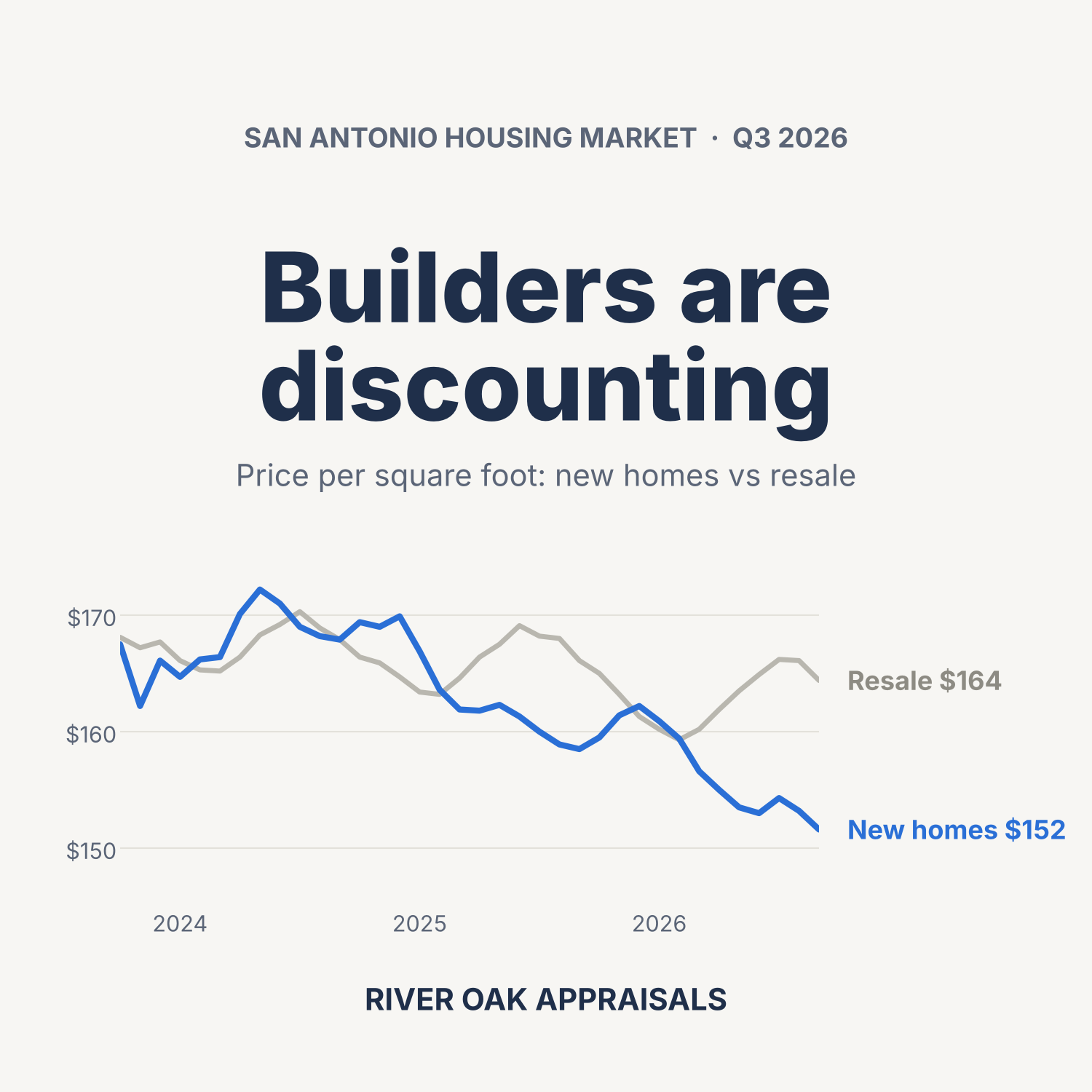
Existing single-family home sales were up 21% year-over-year, with 2,236 closed sales. But the median price for existing homes was down 5% to $300,000, and the average price was down 1%.
That suggests buyers are still active in the resale market, but they are not chasing prices higher. More likely, the market is seeing a mix of price reductions, affordability pressure, and buyers gravitating toward properties that feel like better values.
New construction is a different story.
New single-family construction had 898 closed sales in April, down 26% from last year. At the same time, the median new construction price increased 5% to $314,990, and the average price increased 4% to $352,308.
That looks strange at first glance. Fewer new homes are selling, but prices are higher.
The likely explanation is that builders are not simply cutting base prices across the board. Instead, they may be using a mix of incentives, rate buydowns, closing cost credits, inventory management, and product mix changes to keep sales moving without making the headline prices look dramatically weaker.
That is one of the most important parts of today’s market. The list price does not always tell the whole story, especially with new construction.
Fannie Mae Sees a Slow Improvement, Not a Boom
Fannie Mae’s May 2026 housing forecast lines up with what the local data seems to be showing.
Nationally, Fannie Mae is forecasting total home sales to rise modestly in 2026 and more meaningfully in 2027. Total home sales are projected to increase from 4.755 million in 2025 to 4.853 million in 2026, then to 5.181 million in 2027.
That is improvement, but it is not a floodgate-opening type of forecast.
For new single-family sales, Fannie Mae expects a slight decline in 2026, followed by growth in 2027. New single-family sales are forecast at 679,000 in 2025, 673,000 in 2026, and 698,000 in 2027.
That fits what San Antonio is seeing locally. New construction is not dead, but it is under pressure. Builders are still competing, inventory is rising, and buyers are still payment-sensitive.
Mortgage Rates Are Still the Main Problem
The biggest issue remains affordability.
Fannie Mae’s forecast shows the 30-year fixed mortgage rate averaging around 6.3% in 2026 and 6.2% in 2027.
That is better than the highest-rate periods buyers have been dealing with, but it is still high enough to keep many households on the sidelines.
This is why the market can look confusing. There are buyers out there. There is demand. People still need to move. But the payment has to make sense.
A buyer may like a house at $350,000, but if the monthly payment does not work, the house is still overpriced for that buyer. That is why pricing, concessions, condition, and builder incentives matter so much right now.
More Mortgage Volume Is Expected, But That Does Not Mean the Market Is Taking Off
One interesting part of Fannie Mae’s forecast is mortgage originations.
Single-family mortgage originations are forecast to rise from $1.958 trillion in 2025 to $2.364 trillion in 2026, then to $2.489 trillion in 2027.
That sounds like a big improvement, and it is. But the details matter.
Fannie Mae expects refinance activity to increase significantly, with refinance originations rising from $573 billion in 2025 to $900 billion in 2026. The refinance share is forecast to increase from 29% in 2025 to 38% in 2026.
So yes, mortgage activity may increase, but that does not automatically mean the purchase market is about to explode. A meaningful part of that increase may come from homeowners refinancing if rates ease enough.
For buyers and sellers in San Antonio, that means improvement is possible, but it may still be gradual.
Where San Antonio Looks Like It Is Heading
Right now, San Antonio looks like a market trying to find balance.
There is enough buyer activity to keep sales moving, but not enough urgency to absorb all the inventory without price sensitivity. Existing homes are selling, but pricing has to be realistic. New construction remains very important, but builders appear to be leaning heavily on strategy rather than just simple price reductions.
The most likely near-term path is not a crash and not a boom. It looks more like a choppy, competitive market where well-priced homes move and overpriced homes sit.
For sellers, the lesson is simple: price matters again.
For buyers, there may be more room to negotiate, especially with homes that have been sitting or with builders trying to move inventory.
For agents, the key may be setting expectations early. The market is not dead, but it is also not forgiving. Pricing, presentation, concessions, and timing all matter more than they did during the hotter market.
The Overlooked Point: The Market Is Not One Market
The biggest thing people may miss is that “the San Antonio market” is not moving as one single market.
Resale homes, new construction, entry-level homes, higher-end homes, and different parts of town can all behave differently at the same time.
That is especially true right now because builders are such a big part of the local market. A resale seller may be competing not only with other resale homes, but also with a builder offering rate buydowns, closing cost assistance, or quick move-in inventory.
That can put pressure on resale pricing even when the overall market statistics look stable.
Bottom Line
The San Antonio single-family market is still functioning, but buyers have more choices and more leverage than they had a few years ago.
Sales are holding up, prices are mostly stable, and national forecasts point toward gradual improvement. But elevated inventory, longer marketing times, and mortgage-rate pressure are still keeping the market from taking off.
The next major shift probably depends on rates. If rates move lower and stay lower, more buyers could re-enter the market. If rates stay near current levels, expect more of the same: active inventory, selective buyers, builder incentives, and a market where pricing correctly matters more than ever.
Need a value for a specific property?
Divorce, estate, pre-listing or investment, we can help. Request a quote or call or text (210) 500-7880.