BCAD Cut Home Values Two Years in a Row. Why Didn't Your Tax Bill Drop?
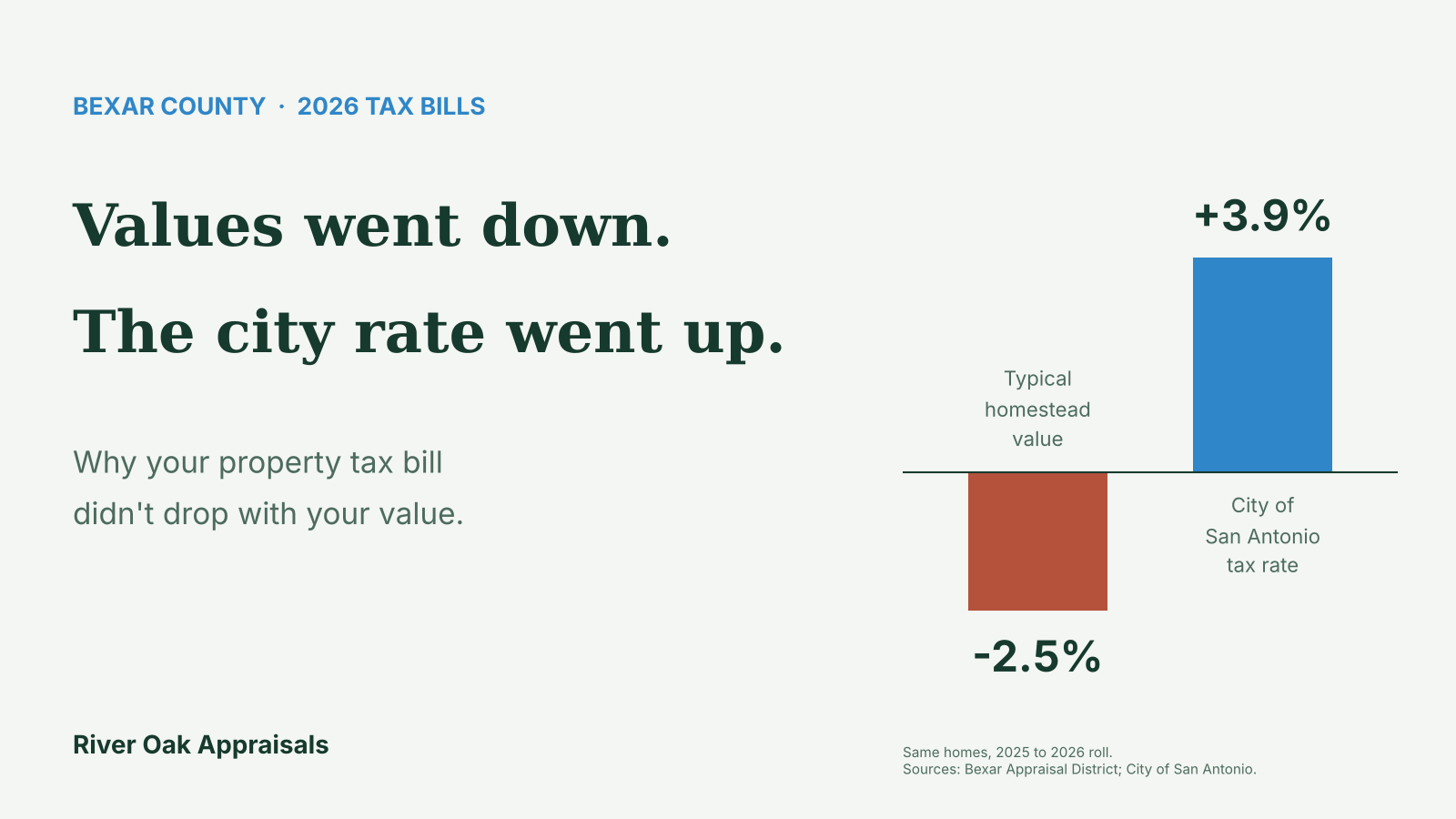
Property tax bills are landing in Bexar County mailboxes right now, and a lot of homeowners are asking the same question: the appraisal district lowered my value, so why didn't my bill go down?
It's a fair question. We pulled every single-family home on the Bexar Appraisal District rolls for 2023 through 2026 and tracked the same homes year to year. Values really did fall. The bill is a different story, and it comes down to how Texas property tax actually works.
The short version:
Your value probably did go down. The typical single-family home in Bexar County was valued 2.8% lower on the 2026 roll than the year before, after a 0.8% dip in 2025. About 7 in 10 homesteads got a lower value this year.
Your bill is value times rate, and rates move when values fall. Taxing units can raise the rate to bring in the same money, and some did. The City of San Antonio raised its rate this year for the first time in more than three decades.
The big homestead break already showed up last year. The school exemption jumped from $100,000 to $140,000, but it applied to 2025 bills. There is no new break on this year's bill to make it look smaller.
Where you live matters a lot. Some south and west side ZIPs are down 10% to 15% since 2023. A handful of north and fringe ZIPs are up.
What happened to values
The appraisal district values every home as of January 1 each year, mostly from the prior year's sales. Looking at the same homes on back-to-back rolls, values were flat in 2024, slipped 0.8% in 2025 and fell 2.8% in 2026.
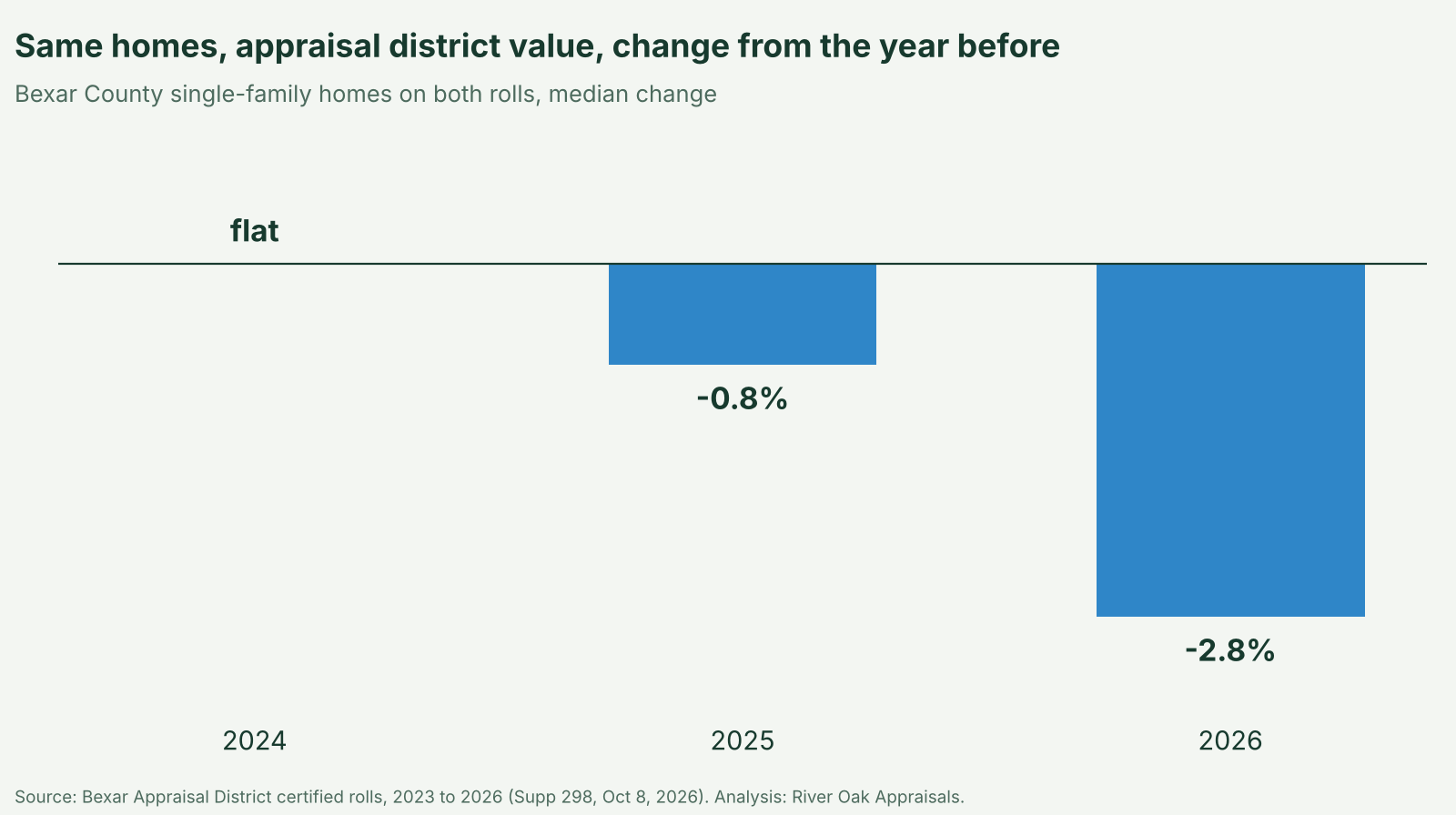
Over three years, the typical home's value is down 5.4%. That is the median of each home's own change, for homes on both the 2023 and 2026 rolls. The median value of all single-family homes on the roll fell from $269,500 to $254,400, or 5.6%. The two don't match because a median of changes isn't the change in medians, and the second number also includes homes added to the roll since 2023. It's also why the yearly figures don't add up to the three-year number.
The drop is not even. Older neighborhoods on the south and west side took the biggest hits. Of the 61 Bexar County ZIPs with at least 1,500 homes, 31 are down 5% or more since 2023 and only 9 are up.
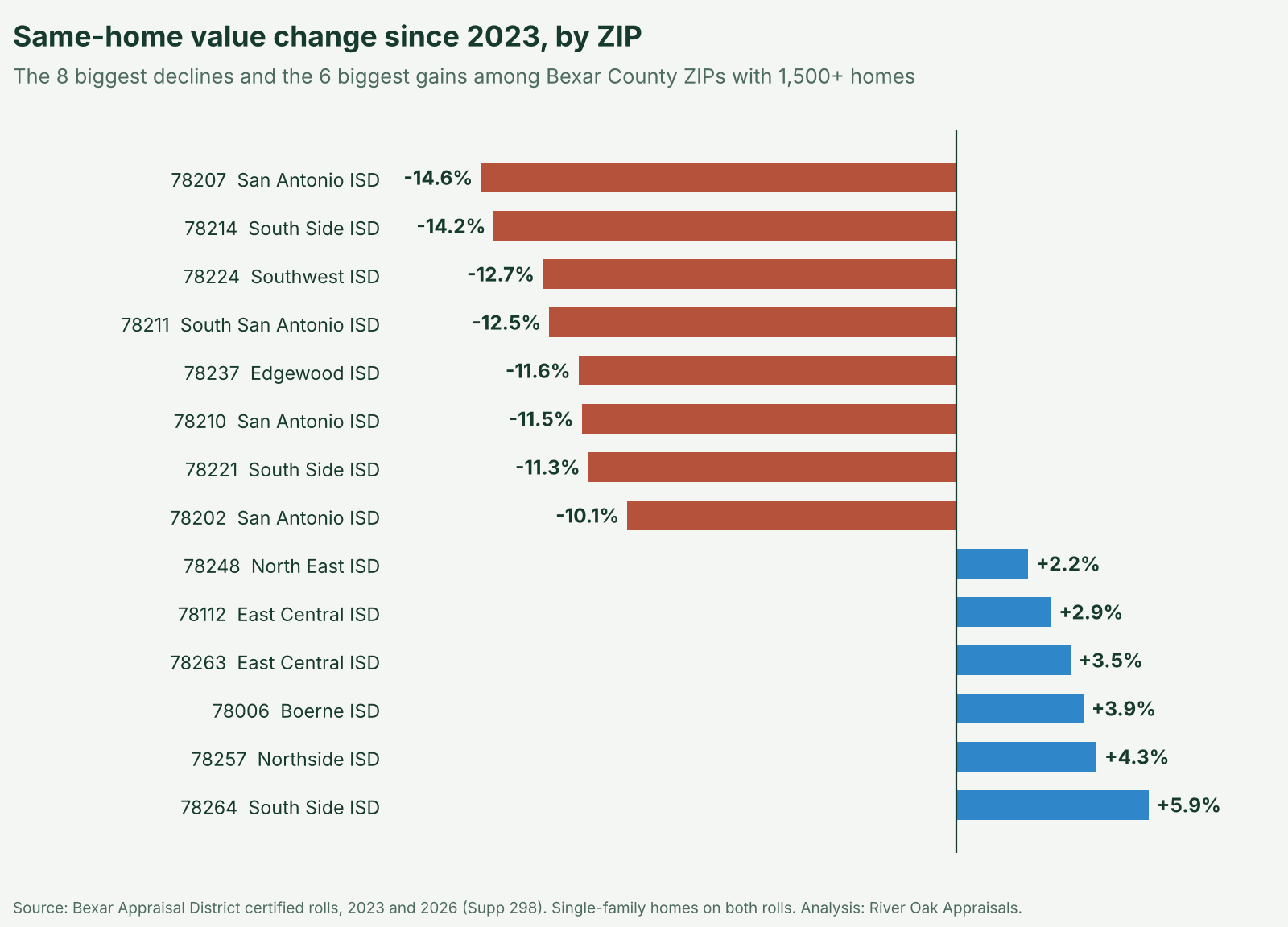
Most of the hardest-hit ZIPs are older neighborhoods, where the typical home was built between the 1940s and the 1960s. The ZIPs that gained are mostly newer areas on the edges of the county and a few established north side neighborhoods.
Why the bill didn't follow
Your tax bill is your taxable value times the tax rate, added up for every taxing unit on the bill: the city, the county, the school district and a few special districts. The appraisal district sets the value. Each taxing unit sets its own rate. When values fall, the rate is where the bill gets made up.
1. Rates can rise when values fall. Every year, each taxing unit calculates a "no-new-revenue" rate. That's the rate that would bring in the same money from the same properties as last year. When values go down, that rate goes up. Cities and counties can go as high as their voter-approval rate without an election.
| Taxing unit | 2025 rate | 2026 rate | What it means for a typical homestead |
|---|---|---|---|
| City of San Antonio | 54.159¢ | 56.288¢ | Rate up about 3.9%. With a value down 2.5%, the city line on the bill goes up roughly 1%. |
| Bexar County | 29.9999¢ | 29.9999¢ | Rate held, below the 30.9043¢ no-new-revenue rate. The county line goes down with your value. |
Rates are per $100 of taxable value. "Typical homestead" means the median change for homesteads on both rolls, before each unit's exemptions.
The city's increase used taxing room it had left unused the two years before. The county held its rate and used reserves to cover the gap. Most of the San Antonio-area school districts that asked voters for higher rates this November were turned down.
2. Last year's bill already had the big exemption. Texas voters approved raising the school homestead exemption from $100,000 to $140,000 in November 2025, and it applied to 2025 tax bills. Homeowners 65 and older or disabled got an extra $60,000 on top. That made last year's school taxes noticeably smaller. This year there is no new exemption, so the school line only moves with your value and your district's rate.
3. The 10% cap works in one direction. On a homestead, the appraised value used for taxes can't go up more than 10% a year over last year's appraised value, plus the value of any new improvements, even when the market jumps. If your appraised value was being held below market by the cap, it can keep creeping up toward market value even in a flat or down year. It never pushes a value down.
What This Means for You
Homeowners: Look at each line on your bill, not just the total. The value on the notice and the rate on each line tell you who changed what. January 31 falls on a Sunday this time, so the last day to pay without penalty is Monday, February 1, 2027.
Think your value is too high? The time to act is spring, when the 2027 notices arrive. The protest deadline is generally May 15, or 30 days after your notice is mailed, whichever is later. Recent sales of homes like yours are the best evidence.
Selling? The appraisal district's number is a mass estimate for tax purposes, not a price. In the ZIPs that fell the most, it may be behind what homes are actually selling for, or ahead of it. A pre-listing appraisal tells you where your home really stands.
Agents and lenders: Buyers are reading these bills too. Expect questions about why taxes didn't drop with values, and point them to the rate, not the appraisal.
We'll keep tracking the rolls each year alongside the MLS, and keep telling you what we see from the appraiser's side of the table.
Source: River Oak Appraisals analysis of the Bexar Appraisal District certified appraisal rolls, 2023 to 2026 (Supplement 298, October 8, 2026), single-family homes (state code A1) on both rolls; aggregates only, no individual properties. Tax rates: City of San Antonio FY 2027 budget and tax rate ordinance (September 2026); Bexar County FY 2026-27 budget and 2026 Notice of Tax Rates. Homestead exemption: Texas SB 4 and SJR 2 (Proposition 13) and Proposition 11, November 2025. School tax rate elections: KSAT and Texas Public Radio, November 2026. This is general information, not tax or legal advice.
Need a value for a specific property?
Divorce, estate, pre-listing or investment, we can help. Request a quote or call or text (210) 500-7880.